The conference "Denial, Distortion, and Disinformation: The Truth About the Holocaust 80 Years After the Liberation of Auschwitz" was organized by the Ministry of Justice on the symbolic 80th anniversary of the liberation of the German Nazi Auschwitz concentration and extermination camp. The event’s date also coincides with the start of Poland’s Presidency of the Council of the European Union.
Copyrights
fot. M. Starowieyska / Muzeum Historii Żydów Polskich
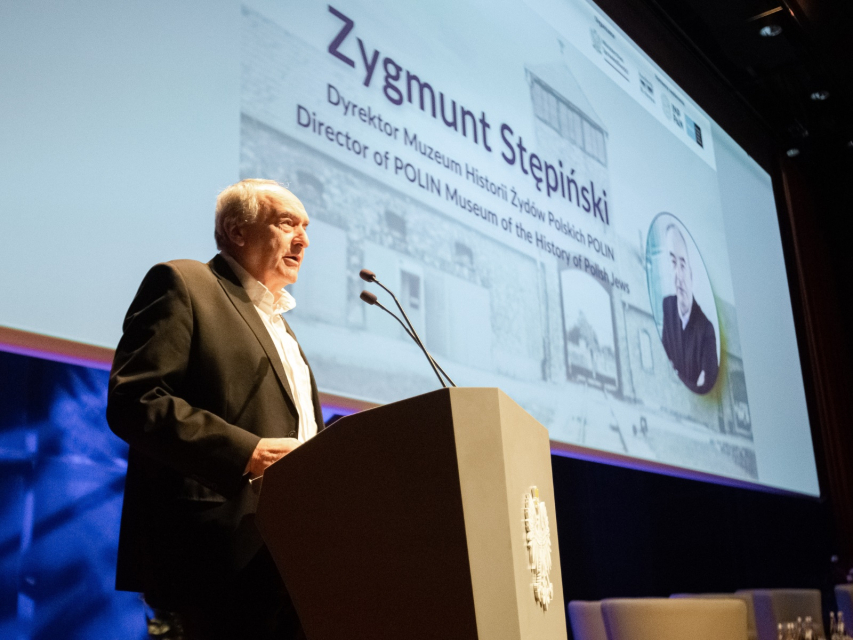
Zygmunt Stępiński, POLIN Museum Director, opened the conference:
"We must never stop talking to our audiences about what lies at the end of the path proposed by xenophobes and racists in the name of ‘defending tradition.’ The traditions they claim to defend have already been carried on banners, paraded in well-tailored uniforms designed by the finest fashion designers. This is not only about knowledge but, above all, about values. About understanding. About empathy. And empathy, ladies and gentlemen, cannot be introduced by law, resolution, or even a well-written document or textbook. It is shaped through conversation, amidst difficult questions and even harder answers. It grows through understanding and respect, within the bonds formed between people.
Auschwitz, if we assume that this symbol of the utter collapse of humanity can be comprehended at all, will not be understood by those who only know the facts, figures, and dates. Only when we stand in front of a pile of shoes and realize that it was merely some cosmic chance that one of those pairs is not ours—only then there will be any chance for catharsis," stressed Zygmunt Stępiński in his speech.
The conference focused on the issue of distorting history in the context of Holocaust atrocities and the rise of antisemitic sentiments and incidents. The event provided a unique opportunity to exchange views and international experiences. It was attended by experts, historians, representatives of cultural institutions, and individuals engaged in efforts to preserve memory and counter antisemitism—prominent scholars, educators, officials, and representatives of the NGO sector.
We also welcomed some guests of honor—representatives of state authorities, Minister Adam Bodnar among them, as well as representatives of the European Union and the European Commission. The conference was also attended by the Chief Rabbi of Poland, Mr Michael Schudrich.