On behalf of all the survivors, I wish to welcome distinguished guests. I warmly welcome all the people gathered in this tent. I welcome the listeners and viewers of the mass media. But, first and foremost, I’m sending my warmest thoughts to you, my comrades in misery, the inmates.
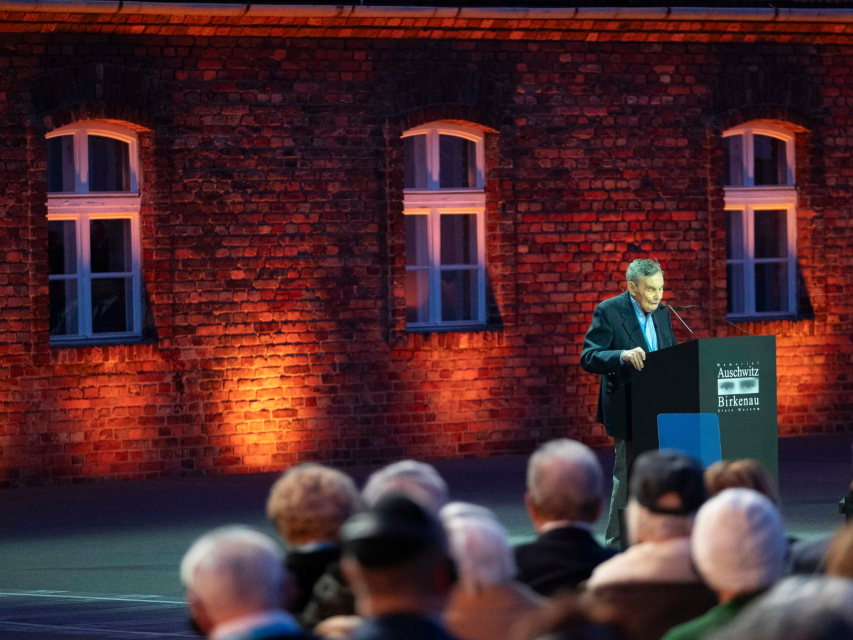
Copyrights
fot. Państwowe Muzeum Auschwitz-Birkenau, W. Grabowski
Today, we are commemorating the International Holocaust Remembrance Day. It is perfectly understandable, obvious even, that people and the media turn to us—those who survived—eager to listen to our stories. But we have always been a tiny minority… There were very few of those who were spared during initial selections. Even fewer lived to see the liberation. Nowadays, there’s a handful of us left. That is why I do believe that our thoughts should go to the vast majority—the millions of victims who will never share with us what they went through or what they felt, because they perished in the Shoah….
We do, however, have a document of sorts—a poem which, to some degree, tells us about these people. It is a poem by—please make sure to remember this name—Henryka Łazowert. Henryka Łazowert was a Polish poet with a substantial literary output to her name. She had a chance to hide outside of the ghetto, but she didn’t want to split with her mother. When I listen to her poems today, they seem timeless, universal. They are a document.
We do have her photo. She was a handsome woman, aged 33. She was already recognized as a poet. She was a Polish poet, for she wrote in Polish. However, as a Jew, she was doomed. She had a chance to hide on the so-called ‘Aryan’ side, but she wouldn’t leave her mother behind. She wrote a letter, a poem really, to a friend of hers. Let me quote it to you:
"I am going away. Far away. To an unknown railway station, not to be found on any map. Above the station, the skies are hanging like an enormous, black lid. The engine has a voice of a man who’s being assaulted. The railwaymen’s faces are made of paper. I have but one suitcase, and one regret that no one has ever tried to address. I am very calm and—what may not seem obvious—very saddened. Be well, my faraway one. Some hearts remain unchanged. I am no more. No more."
I kindly ask everyone present to stand and observe a minute of silence.
Thank you.
Dear friends, the apocalypse has been looming for at least two thousand years now. Here come the Four Horsemen of the Apocalypse: War, Disease, Famine, and Death. People are overwhelmed with fear, paralyzed by it. They feel utterly helpless. What can be done? I would like to quote a song here, one that many of you would surely recognize if I were to hum it. Don’t worry—I’m not going to sing. I do wish, however, to draw your attention to the text, as it is truly inspiring. Rabbi Nachum of Bratslav is the author, better known as Rabbi Nachman of Uman, for that’s where he wished to be buried, among the graves of pogrom victims.
"Our whole world, the world, our world, is akin to a very narrow bridge. But the most important thing is: Do not be afraid!"
Therefore, fear not! We can observe a significant rise of antisemitism in today’s world, and yet it was precisely antisemitism that led to the Holocaust. Deborah Lipstadt dubbed it "a tsunami of antisemitism." Meanwhile, it was her courage, persistence, and determination in the fight against Holocaust denial that culminated in success—winning the trial against David Irving in London.
Let us not be afraid to show the same courage today, when Hamas makes attempts at denying the October 7 massacre. Let us not be afraid to counter conspiracy theories, ideas that all that is wrong with the world is the result of plots by unspecified social groups, with Jews often being mentioned among them. Let us not shy away from discussing the problems that trouble the so-called Last Generation. While these young people may disrupt our system of order or our legal system, the judge who delivered the verdict uttered significant words:
"Perhaps today I am convicting tomorrow’s heroes."
Let’s not shy away from convincing ourselves that it is indeed possible to resolve problems between neighbors. For hundreds of years, on different continents, different nations, nationalities and ethnic groups lived side by side and among one another. Mutual prejudices, animosity and hatred led to armed conflicts between these neighboring nations and ethnic groups. These always ended with bloodshed. Fortunately, there are also positive examples, when two sides come to conclusion that there is no way other than reaching a compromise to ensure their children, grandchildren and future generations enjoy a safe and peaceful existence. I could quote two examples from Europe—Germans and French, Poles and Lithuanians.
Let me repeat—let us not be afraid to convince ourselves that we need a vision of not only the present, but also of the future, of what’s going to happen in the decades to come.
Thank you for listening.