The roundtable "Confronting the Truth: Neighbors and the Evolution of Polish Holocaust Discourse" accompanies the international conference "Confronting Holocaust Distortion in the Digital Era". Roundtable in Polish with English translation.
Copyrights
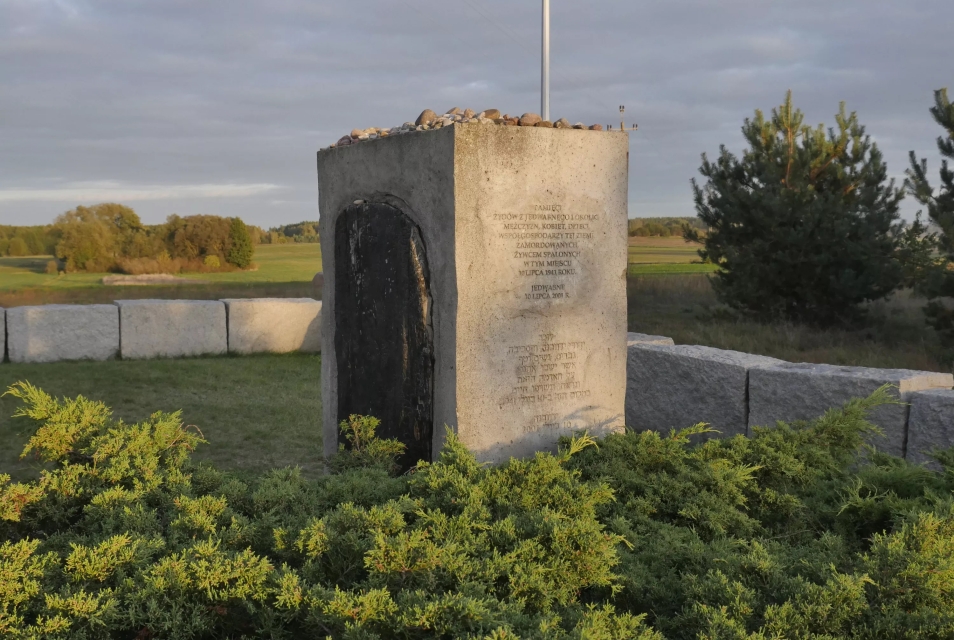
“Monument commemorating the victims of the Jedwabne massacre” photo: Piotr Ostrowski/ POLIN Museum
25 years ago, Jan Tomasz Gross published his landmark book Neighbors, which brought the massacre of Jews in Jedwabne—perpetrated by some of their neighbors—into the forefront of public consciousness. The book irrevocably challenged the notion that Poles did not participate in the Holocaust. Since its release, reactions have ranged from defensive denial to deep introspection and shame, but also a decades long debate that uncovered deep divides in the collective memory of the country. "Neighbors" managed to cause much more than a momentary scandal, it was a decades-long process that fundamentally altered the discourse surrounding the Holocaust in Poland.
This discussion will show how Gross’s work reshaped Poland’s conversation about its wartime past over the past quarter century. We will explore both the narratives of historical distortion and the courageous efforts to confront uncomfortable truths, tracing the evolution of public memory and historical accountability.
- Moderator: Prof. Piotr Forecki (UAM)
- Panel:
- Dr Krzysztof Persak (POLIN)
- Dr Agnieszka Haska (IFiS PAN)
- Prof. Joanna Tokarska-Bakir (Instytut Slawistyki PAN)
Prof. Piotr Forecki, political scientist, Department of Political Culture, professor at the Faculty of Political Science and Journalism, Adam Mickiewicz University. He has lectured at the Adam Mickiewicz University's Borderline Issues Laboratory and at the Jewish Open University at the Yiddish Culture Center. As part of scholarship programs, he has lectured in Israel, Germany, France, and Italy. In 2014-2016, he was a member of the interdisciplinary Antisemitism Research Laboratory established at the Jewish Historical Institute. He has collaborated with the Polish Institute in Tel Aviv, the Auschwitz-Birkenau State Museum, and the POLIN Museum of the History of Polish Jews. He is the author of three monographs and articles published in various journals, such as Zagłada Żydów. Studia i Materiały [The Holocaust. Studies and Materials], Studia Litteraria et Historica, Środkowoeuropejskie Studia Polityczne, Przegląd Politologiczny, Studia Kulturoznawcze, Poznańskie Studia Polonistyczne, Krytyka Polityczna, OKO.press, and Więź.
Dr. Agnieszka Haska, sociologist, cultural anthropologist, assistant professor at the Center for Holocaust Research at the Institute of Philosophy and Sociology of the Polish Academy of Sciences. Her research interests cover a wide range of topics – from the discourse on collaboration during World War II, through stories of attempts to save Jews using passports from other countries, to an anthropological look at various forms of memory and post-memory, and an analysis of contemporary antisemitism. She is the author of books including: Jestem Żydem, chcę wejść, Hotel Polski w Warszawie 1943 [I Am Jewish, I Want to Enter, Hotel Polski in Warsaw 1943] (2006) and Hańba! Opowieści o polskiej zdradzie [Shame! Stories of Polish Betrayal] (2018).
Prof. Joanna Tokarska-Bakir, cultural anthropologist, religious scholar, and literary scholar, employed at the Institute of Slavic Studies of the Polish Academy of Sciences. Her research interests focus on historical anthropology, ethnography of the Holocaust, anthropology of violence, and issues related to accusations of ritual murder (blood libel). She is a member of the Committee on Cultural Sciences of the Polish Academy of Sciences and the Committee on Ethnological Sciences of the Polish Academy of Sciences, and also sits on the Scientific Council of the Institute of Slavic Studies of the Polish Academy of Sciences. In her research, Prof. Tokarska-Bakir tackles difficult and often controversial topics, analyzing the mechanisms of violence, collective memory, and Polish-Jewish relations in the 20th century. Her publications, both monographs and scientific articles, are widely discussed and have received numerous awards. Her most important publications include: Cursed. A Social Portrait of the Kielce Pogrom (2023), Jewish Fugitives in the Polish Countryside (2022), Pogrom cries: Essays on historical anthropology of Poland 1939–1946 (2019).
Dr. Krzysztof Persak, historian, research fellow at the Institute of Political Studies of the Polish Academy of Sciences and the POLIN Museum of the History of Polish Jews, researcher of modern Polish history, the communist system, transitional justice, Polish-Jewish relations, and the Holocaust. Between 2000 and 2016, he was associated with the Institute of National Remembrance. He was a scholarship holder of the Foundation for Polish Science, the Woodrow Wilson International Center for Scholars in Washington, D.C., and the Imre Kertész Kolleg Jena. His publications include Odrodzenie harcerstwa w 1956 roku [The Rebirth of Scouting in 1956], Wokół Jedwabnego [Around Jedwabne], with Paweł Machcewicz), and Sprawa Henryka Hollanda [The Case of Henryk Holland]. He is the editor of numerous collective works and source editions. He is a winner of the History Award of the weekly magazine Polityka.
Confronting the Truth: "Neighbors" and the Evolution of Polish Holocaust Discourse
6PM
18.11.2025 - 18.11.2025
POLIN Museum of the History of Polish Jews
Free admission