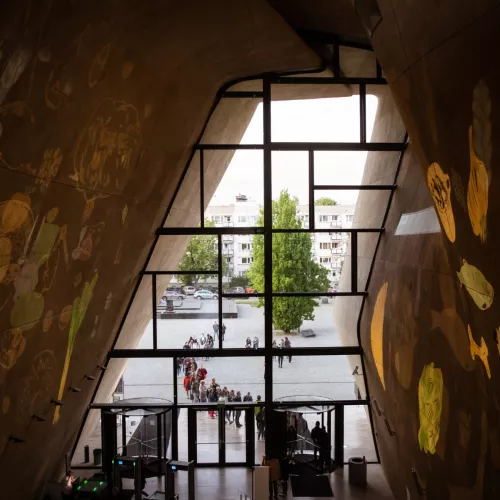
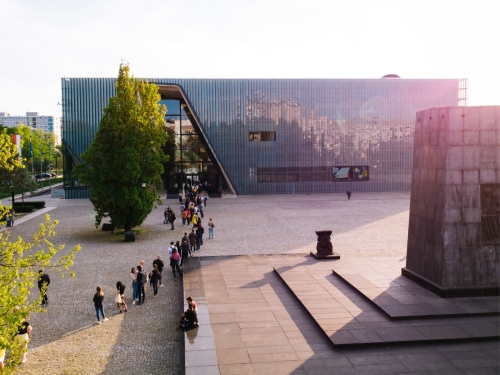
What language do Jews speak today? What does Yiddish sound like — omnipresent in the streets of Polish towns and cities before the War, today barely audible? What does it have in common with Hebrew, Judeo-Arabic, Judeo-Persian or Ladino? You can find out everything at our new exhibition, “The Power of Words. On Jewish Languages.”

"The Power of Words" exhibition presents languages that accompanied Jews scattered across the globe over the centuries. It is a tale of how languages grew to become the space of cultural development for a people living in dispersion. They shaped the sphere of the sacred, everyday communication, as well as religious, social, local and national identity, drawing strength from diversity and cultural continuity.
Hebrew is at the core of this tale — an ancient language, a sacred language, a modern language. We invite you to get acquainted with its alphabet — to watch, listen and write, to get immersed in a space filled with letters, as if they were an intricately woven ornament. It is a unique opportunity to learn about Jewish culture and discover its echoes in our everyday conversations.
Hebrew – more than a language
We begin our journey at the source — from the Hebrew alphabet and the ancient history of the Hebrew tongue. Even though it had not been used as an everyday language for many centuries, it was preserved in prayers, rituals and Holy Scripture. For 2,000 years, it has been a living language of spirituality, a carrier of tradition and identity.
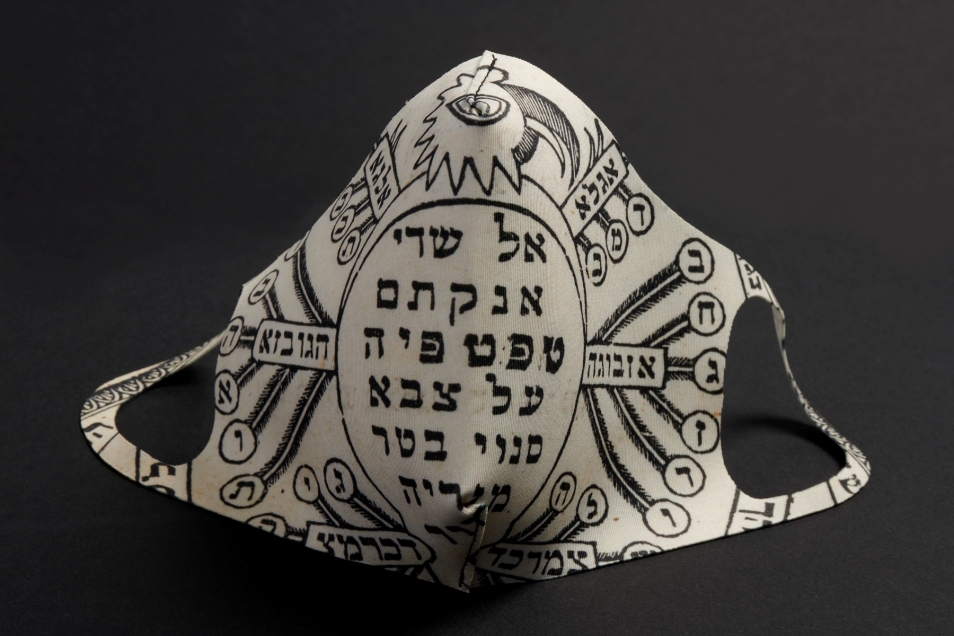
The sanctity of the Hebrew language stems from its deep connection with the Torah — handed down, according to tradition, precisely in this language. After the destruction of the Jerusalem Temple, studying the holy text and commenting on it was the foundation of Judaism’s continuity. A mystical tradition attributed divine power to the Hebrew letters — Kabbalists believed that these letters had taken part in the act of Divine Creation. Hebrew inscriptions adorned synagogues, ritual objects and amulets, while citations from the Torah appeared widely across the religious space.
In the exhibition, we also present the process of a "revival" of the Hebrew language. In the late 19th and early 20th century, it began to be used in the secular sphere, too — initially as a language of literature and press, and subsequently as a language of daily use in the newly established Jewish state.
Copyrights
Pandemic mask/amulet designed by Ken Goldman (b. 1960), Israel, 2020, POLIN Museum of the History of Polish Jews
A Jewish language, meaning?
Today, when we use the phrase ‘Jewish language’ in Poland, we think either of Hebrew or of Yiddish. Meanwhile, there are very many Jewish languages in the world and this fact by no means hinders cultural continuity—on the contrary, it nourishes and strengthens it.
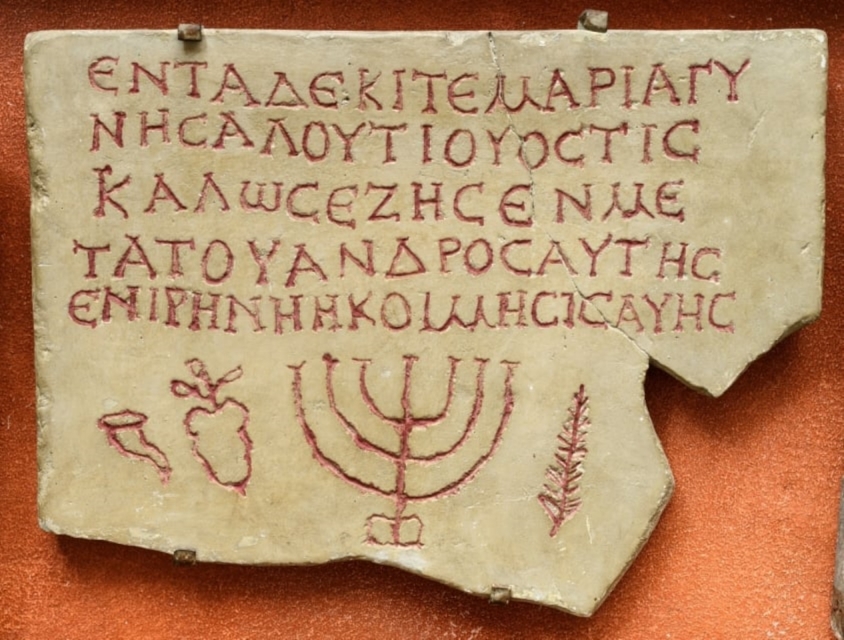
By migrating and settling in different corners of the globe, Jews formed languages that combined the influences of local languages with the elements of Hebrew—words, grammatical constructions and, above all, the Hebrew alphabet which was used to write the new languages down. This is how languages such as Judeo-Arabic, Judeo-Persian, Ladino (Judeo-Spanish), Judeo-Italian or Yiddish—the languages we mention in the exhibition—came into being.
As a result of these processes, Jewish communities in the past were mostly multi-lingual. Hebrew was used in the religious and ritual sphere, secular Jewish languages—e.g. Yiddish or Ladino—were used in daily communal life, and local languages (with a palpable Jewish element) were used in contacts with local populations. This contributed to a high sensitivity and self-awareness of Jewish culture in linguistic matters.
Copyrights
Inscription on the tombstone of Maria, wife of Saloutios in the Monteverde Catacombs in Rome, 3rd–4th cc.,Vatican Museums, copy in the Jewish Museum of Rome, Photo by Giorgio Benni
Words and images
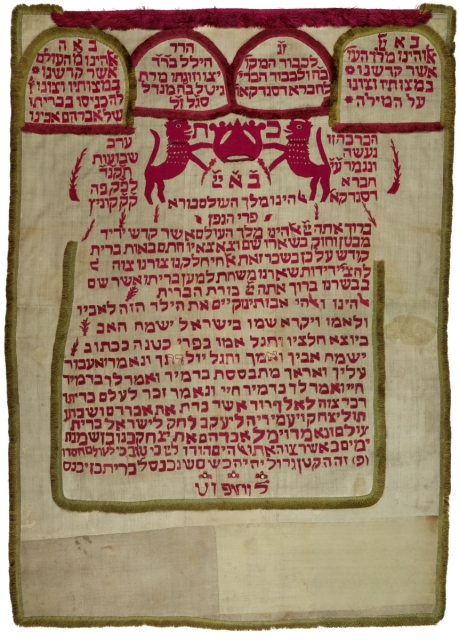
In "The Power of Words" exhibition we present several dozen original objects related to successive chapters of the long story we tell, such as a Babylonian magic bowl with Aramaic inscriptions (2nd c. CE), Jewish tomb stelae with Greek epitaphs (1st c. BCE), a Sephardi Torah mantle (17th c.), richly decorated Hebrew-inscribed parochets—ornamental curtains protecting the Holy Ark housing Torah scrolls (18th c.), a good number of Hebrew amulets (19th–20th cc.), and an illuminated Hebrew prayer book (14th c.). Also special are the reproductions shown at the exhibition—they allow visitors to immerse themselves in the world of archaeological finds, illuminated manuscripts and early prints, as well as modern Jewish visual culture—press, posters, and books.
Copyrights
Parochet donated on the occasion of circumcision (brit mila), linen, red appliqué, and fringe, Dolní Kounice, Central Moravia, 1794, Jewish Museum in Prague
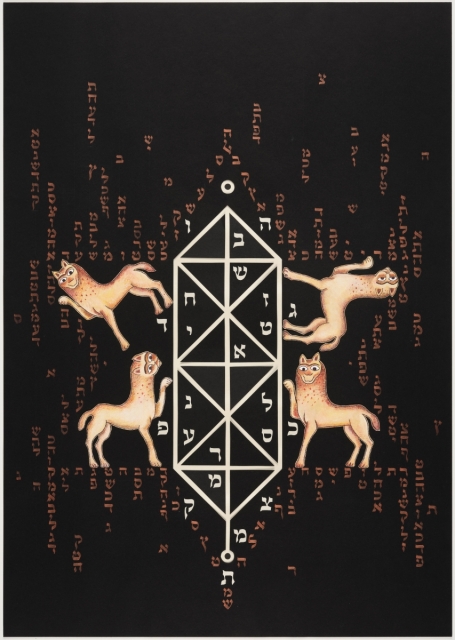
Contemporary art constitutes an important part of the exposition. The connection between word and image, as well as the idea of the power of words and letters—which has been essential in Jewish culture over the course of centuries—remain present in the work of Jewish artists today. The exhibition features pieces by Mordechai Ardon, Moshe Castel, Monika Krajewska, Ewa Gordon, Helena Czernek, and Mark Podwal. We also present two artworks created especially for this exhibition: Oded Ezer’s installation titled "Broken Language" and the "Pseudo-territory" video installation by Ella Ponizovsky Bergelson and Anna Elena Torres, documenting the two artists’ project of the same title shown at the Venice Biennale in 2022.
Copyrights
Ewa Gordon, Matrix, mixed technique, 2007, POLIN Museum of the History of Polish Jews
Language matters
Getting acquainted with the story of the power of Jewish languages—their diversity and continuity, the attachment to and deep respect for the alphabet—allows us to better understand the Jewish world, a world where language is not only a tool of communication but also the living fabric of memory and identity.
The exhibition also offers a space for universal reflection on how languages intertwine, how they influence one another and change in the rhythm of migration, encounters, and global culture. It is also an invitation to look at our own linguistic heritage—to ponder over our own language: where it stems from, how it develops, and where it may lead us.
"The Power of Words" exhibition is organized by POLIN Museum of the History of Polish Jews in cooperation with the Jewish Museum in Prague.
The Team
- Curated by: Tamara Sztyma
- Exhibition coordinators: Cezary Wicher, Katarzyna Tomczak-Wysocka
- Exhibition design: ONTO | Kaja Nosal i Anna Wręga
- Artists: Mordechai Ardon, Menchem Boas, Moshe Castel, Karel Cudlín, Helena Czernek, Oded Ezer, Ewa Gordon, Victoria Hanna, Maria Ka, Daniel Kahn, Monika Krajewska, Mark Podwal, Ella Ponizovsky Bergelson, Joachim Seinfeld, Michal Shomer, Anna Elena Torres, Agnieszka Traczewska
- Consultants: Angelika Adamczyk, Sarah Benor, Łukasz Kalużny, Marta Kacprzak, Monika Krajewska, Ivan Kohout, Piotr Kowalik, Jaroslav Kuntoš, Anna Michałowska-Mycielska, Michaela Sidenberg, Magdalena Sommer, Karolina Szymaniak, Lidia Tuwalska-Napiórkowska, Lenka Uličná
- Head of POLIN Exhibitions Department: Joanna Fikus
- Registrars: Małgorzata Bogdańska-Krzyżanek, Aneta Jasionek
- Conservators: Agnieszka Cyrulik, Erika Krzyczkowska-Roman
- Licences: Anna Rechentiuk-Tyszka
- Catalogue: Marta Markowska
- Visual identity and catalog design: Tomasz Frycz
- Translation: Zofia Sochańska, Karolina Szymaniak, Anna Szyba
- Proofreading of English: Intonation Warsaw
- Proofreading of Polish: Beata Słama
- Multimedia: Robert Latoś, Sławomir Łuczak
- Promotion: Olga Kaliszewska, Katarzyna Miętus, Nina Nowakowska, Sandra Sieluk, Julia Sienkiewicz
- Accessibility: Kamil Gibas
- Accompanying program coordinator: Monika Kołacha, Magdalena Maślak, Marta Sarnowska
- Special thanks to: Alona Bach, Barbara Kirshenblatt-Gimblett, Tom Maitav, Ethel Niborski, Matan Shefi, Jakub Skrzypczak, Adam Włodarczyk
- Thanks to the Museum staff for their support in organizing the exhibition
"The Power of Words. On Jewish Languages" exhibition
Temporary exhibition
21.11.2025 - 08.06.2026
POLIN Museum of the History of Polish Jews